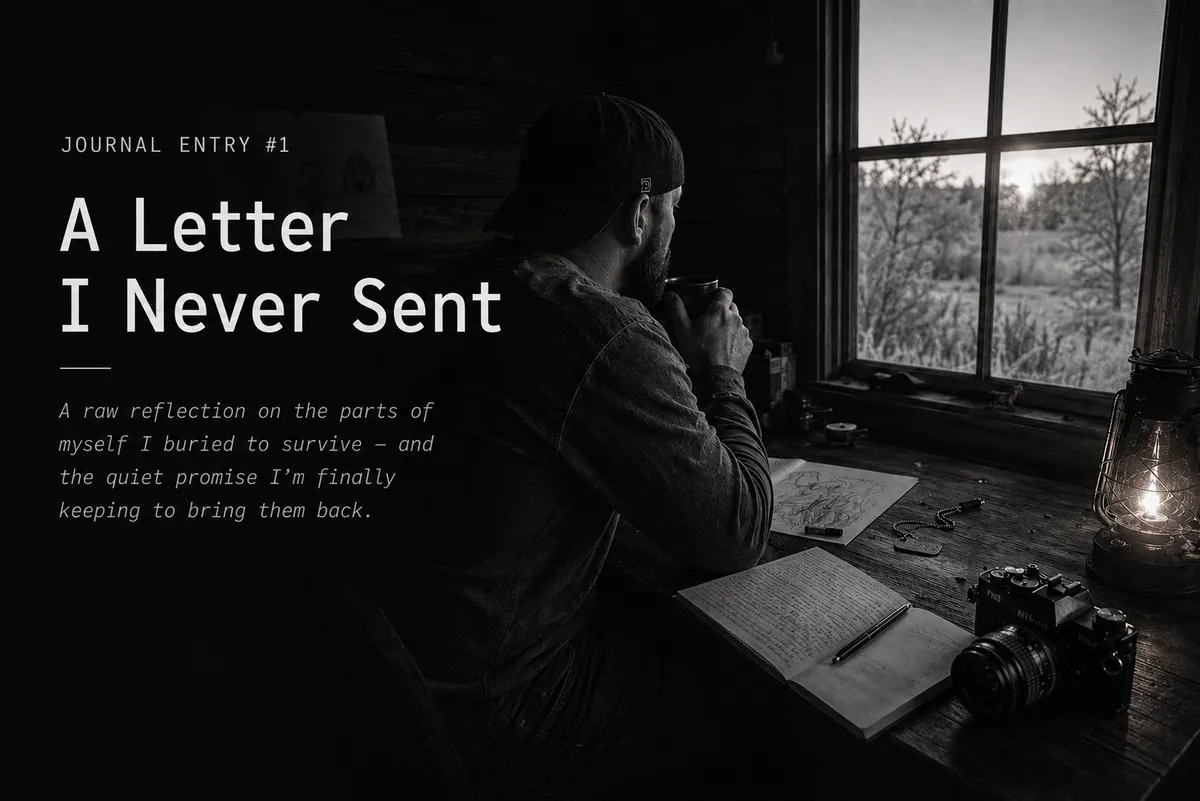
A Letter I Never Sent
A raw reflection on the parts of myself I buried to survive — and the quiet promise I'm finally keeping to bring them back.
- mood
- calm, reflective, nostalgic
- energy
- medium
- weather
- overcast
- music
- "Japan Lo-Fi"
You’re still in there, somewhere.
I know because I still reach for the things you reached for — the music, the art, the camera. I still stop in the middle of a walk when the light does something I wasn’t expecting. I still look up, just like Grandma always said to, but I also look around. You’re more aware than ever now.
The house was loud and quiet in the wrong ways. You learned the difference early — which kind of silence meant safe and which kind meant leave the room.
No one in that house was making art. No one was talking about what or who they wanted to be. The adults were surviving. A kind of survival that had a sound to it. The crack of a can. Coughing. A door closing harder than it needed to. Voices that started low and ended in shouting and physical confrontation.
You were small. Small people in loud houses learn one of two things — how to be louder, or how to disappear. You disappeared, but not entirely. That’s the part they missed.
You drew things. These days I can’t remember what. Animals, maybe. Monsters. Worlds that didn’t look like the one you were standing in. Nobody told you to.
No one handed you a pencil and said, “Here. Try this.” You just…reached for it — the way a plant reaches for diffused light through the window.
Then came sound. Music. You heard something — a guitar, a song on the radio, a note that landed in your chest and stayed — and you thought, I want to make that. I want to be the person who makes that sound.
Art became music. Music became the thing you did when the house got too loud. You’d close a door and the world would shrink to the size of the fretboard. Nothing else mattered.
They told you it was a waste of time. That you’d never make anything of yourself. People like you — people from this house, this family, this area — don’t get to want things like that.
But you didn’t care. You looked up.
Eventually the closed door wasn’t enough. You needed a way out that would hold. And so you left.
You joined because you needed a floor to stand on. They gave you one — concrete, six inches thick, with rules painted on it in yellow.
The uniform was the first thing you ever wore that made people stop telling you what you couldn’t become. You stood different for the first time in your life. Someone handed you a mission and said, “We trust you to carry this.”
And you carried it. Aberdeen, McCoy, Baghdad. You carried it in the heat, in the cold, through the diesel smoke and the days that blurred into each other until you couldn’t remember what month it was, only what needed to happen next.
You were good at it. That’s not pride. It’s the truth. Good at the structure even when you didn’t want to be. Good at the mission. Good at being the person others could lean on.
But the guitar stayed in the case, the sketchbook stayed in your footlocker, and the camera had long since disappeared. The part of you that made things — that reached for the pencil before anyone told you to — you put him in a room, closed the door, and locked him away. You told yourself it was discipline, but it felt like you were dying.
Then you became a man. Not because of the uniform, but because of the small hands that grabbed your finger and didn’t let go. You looked at those hands and made a deal with yourself. A quiet one. The kind no one would witness. You said, “I will give them what I never had. I will be steady. I will be present. I will never leave you. I will never fall apart.”
And you did. You left the hell of that previous life behind. You started over, built a career, and climbed. You sat in meetings, wrote reports, managed teams, and did every single thing the adults in your life never did. You showed up. Every day. Reliable. There. But the deal came with a price and you didn’t read the fine print.
The art. The music. The images. It all left. Soon, that feeling you used to get standing outside at night, looking up into that endless ocean of stars, something bigger than yourself — that would leave too.
You traded it all for stability. And for years you told yourself it was the right call. Good fathers don’t chase dreams. Responsible people don’t sit in fields at dawn with a camera or a sketchbook. Wanting something for yourself is the same as taking something from them.
But you were wrong. It took you a long time to realize this. An even longer time to say it out loud.
Resentment doesn’t show up all at once. It moves like weather. Like a slow overcast. One day you look around and can’t remember the last time you felt the sun on your face. Your limbs become as dead and brittle as the old maple along the road.
You stopped making things and started managing them. You stopped seeing and started reporting. You woke up at 5 a.m. to catch up on emails, not to catch the light. But you hid it so well. The bitterness. No one knew that boy was still in there, starving. No one except you.
He lay awake, barely alive. Still in that room you locked him in. Still reaching. Still hearing. Still pressing his face against the glass. All you had to do was listen. And you did.
That was the price. I can’t remember the exact day I broke. There wasn’t a single moment. No dramatic scene. No rock bottom. More like a crack. Then another…and another.
One morning I picked up a stick of charcoal and started drawing. I pulled the guitar out of its case and played. I took the camera outside and saw hoar frost. I wrote about it and cried.
I’m writing this letter to you because I love you and I owe you an apology. I locked you away. I told you that you were not useful. That the things you loved were liabilities. That your creativity was a burden I could no longer carry. I was wrong.
The thing no one could ever have told us — in that house, that uniform, that office — is that the creative part isn’t separate from the rest. It’s not a hobby or a side project. It’s the engine. When we shut it off we don’t become more focused. We become less alive.
I want you to know that we’re nearing forty and, once again, stepping away from a career we thought we needed. The career that proved all of them wrong. The one that would allow us to move away from the trauma. But proving them wrong was the wrong motivator. I finally understand that was never the point. The point was always the looking. The making. Reaching for something when no one told us to.
I never forgot. I got lost. Without you, we never could have become who we are. I love you, and I’m looking up again.
Comments
Write a comment
Opening the form loads a spam check from hCaptcha.
Comments come to me by email. I read every one and publish some by hand — yours won't appear right away, and it may not appear at all. If it's published, your name and your words become a public part of this site; if you ever ask me to take it down, I will, though this project's private history may still hold a copy. Your email address is never published or stored in the project.